

It’s time for yet another spring property market update with the wonderful Kellie Landrey – principal Buyer’s Agent at Scoutable – whose down to earth approach to property buying and accessible, relatable market insights always leave us feeling better informed.
Executive Summary
KEY INSIGHTS:
- Supply shortage is driving competition: Stock levels are down 20% compared to last year, creating intense competition in the $1M-$2M price range.
- Rate cuts are already pushing prices up: Buyers can afford more, leading to properties selling $30k+ above fair value.
- Home Guarantee Scheme changes will impact in October: New $1.5M cap will increase buyer pool by 30% in eligible suburbs.
- Melbourne offering good value currently: Years of flat growth making it undervalued compared to other capitals.
- Buyer tip - don't try to ‘time’ the market: Focus on finding good value within your budget rather than waiting for the 'perfect' moment.
- Don’t skip the pre-approval: One of the biggest mistakes buyers are making is looking at properties without their finance sorted first.
Section 1: Spring Market Conditions
Pure Finance: Hey Kellie, it’s nice to catch up with you! So, it’s Spring again (if you can believe it?!) and we’ve finally had those promised rate cuts - three at the time of this chat. To start things off, what is the vibe you’re noticing in the property market at the moment?
Kellie Landrey: Hey team! Always great to have these chats... So, given that my work is predominantly based in Sydney, and even more so the inner-city, I'm noticing that buyers have more confidence now, compared to six months ago, based on the interest rate movements we’ve seen this year, which have certainly helped. But supply levels are still a significant issue, in that there just aren’t enough properties out there for people to buy.
And that’s putting pressure on pricing, and bringing that ‘FOMO’ situation well into play – especially for properties in the inner city ring with a <$2M price point – and it's also having an impact on the speed at which people are trying to purchase properties.
"I'm finding that some people are overpaying due to caps on how much people can spend... within certain price brackets, people will spend more than what the property is worth, because they can't get into the next pricing tier of the market."
I’m also finding that some properties are selling well above what they’re worth. To give you a current example: there was a property in Dulwich Hill – Art Deco unit, two bedrooms, a garage but no balcony. Very pretty, beautifully renovated. They had 10 registered bidders (at auction) and the price guide was originally $1.1M, with the vendors happy at $1.3M. Throughout the campaign, they increased the price guide from $1.1M to $1.15M, then $1.2M to $1.25M, and then again to $1.3M, where they stopped the guide. It then sold at auction for $1.61M.
PF: Woahhhhhh!
KL: Yeah. And a house just around the corner from that one sold for $1.9M only a month ago. So, that’s a $300k price differential between an apartment with no outdoor space, equally renovated and on a very similar street (ie, only 100m from each other). The house had parking, two bedrooms and a courtyard and was beautifully renovated. The apartment had two bedrooms, no outdoor space, parking, strata vs torrens title. There should be more than a $300k difference between the two of them.
And so, I’m finding that some people are overpaying due to caps on how much people can spend. And what I mean by that is, within certain price brackets, people will spend more than what the property is worth, because they can’t get into the next pricing tier of the market.
Also, if we look at the <$2M market, I’m finding that there’s a lot of mum and dad’s out there helping their kids. I’m seeing it at almost every single property I’m looking at; for my investor clients, first home buyers, or those looking to upgrade their homes in that $1M to early $2M price bracket. That’s another big trend that I’m seeing, which we’ve always known was happening but, it’s really obvious at the moment.
PF: What sort of feedback are you getting from buyers and sellers at the moment, based on the properties that are or aren’t selling?
KL: The ones that are selling really well are in that $1M to $3M price point, if they are priced accurately. So, they’re going pretty strong, especially in the $1M to $1.2 - $1.3M range. As long as there isn’t anything drastically wrong (e.g., no major strata issues) then these are the properties that are just, sort of, flying out the door.
The only properties that are struggling to sell at the moment, are ones where the vendor has unrealistic price expectations. Or, if it’s an apartment with significant strata issues i.e. how they have managed that process over time, and the impact on the strata levy situation. These properties can struggle if the vendor’s expectations are in comparison to an apartment complex that hasn’t got the same issues. The value proposition between those two situations can be quite drastic, and can really influence how long a property might stay on the market, based on how realistic the vendors have been about factoring in those issues.
PF: We know that Spring is traditionally the biggest selling season but, it feels like this is becoming less clear cut with each passing year. Would you agree?
KL: There was a lot of talk during winter of ‘just wait for spring, there’s going to be heaps coming’. But, I found that while there is definitely an improved quality of stock, it’s still down 20% compared to this time last year and the five year average. And now that we’re 19 or so days into spring, I’m querying how strong of a spring season we’re actually going to have.
PF: And do you expect the 2025 Spring season to differ from previous years in terms of stock levels, competition, and overall market activity?
KL: I think there is going to be some sort of inbuilt demand from the federal government scheme changes but that things might not be that dissimilar to last spring? I think there should be some more stock coming onto the market, but I don't think it’s going to be drastically different from last year, meaning this will affect demand. So, the buyers are more in force than they were last year and if the supply doesn’t increase at all from last year, or doesn’t improve percentage wise, then this imbalance will mean we are going to potentially have more pressure on pricing.
So, the ‘issue of the day’ (which has been the ‘issue of the day’ for many years now, but has been compounding), is that our supply is really lagging.
Section 2: The Effect of Recent Policy Changes & Rate Cuts
PF: How are the recent rate cuts (in February, May and now August) actually influencing buyer decisions and market activity? Do you think buyer behaviour has shifted over the last few months and that we’re seeing genuine price corrections in any areas? Or is it more about reduced growth rates?
KL: The current growth rates in Sydney are marginal, you know? They’re very small in relation to the past 10 years, but I don’t think this is really being influenced by the interest rate movements, it’s just that we’re in a slow growth environment at the moment.
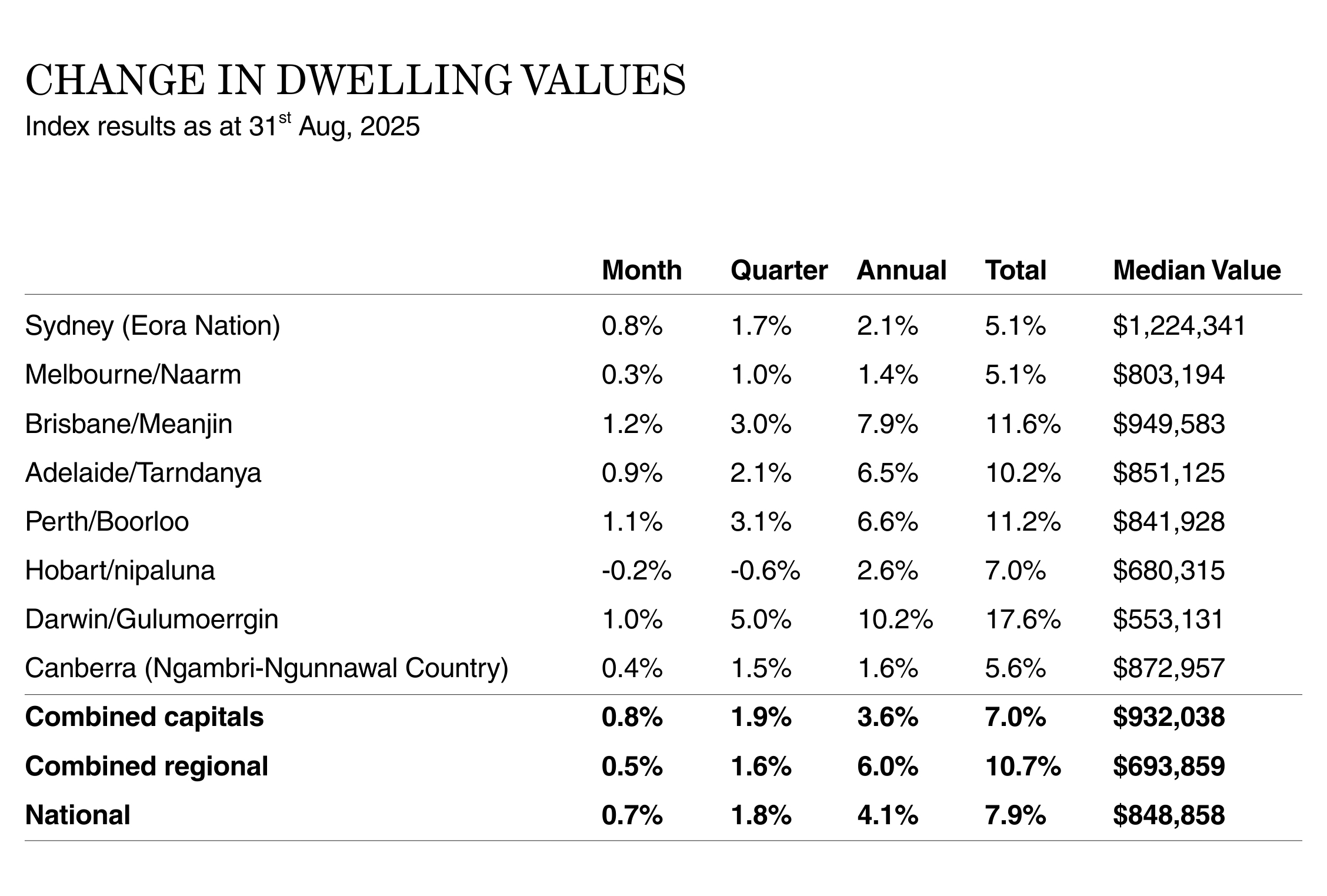
Sydney was at 0.8% for the month of August, 1.7% for the quarter and 2.1% for the year. Whereas, what we want to be seeing are average growth rates from, say, 6-8% per annum over a blended 10 year period. So, we’re in a low growth environment currently, but we’re coming off the back of a really high growth period.
In terms of rate cuts, I've got a pretty good example from a couple of days ago. I have an investor client with a budget just shy of $1M looking at an apartment in Randwick. There was an art deco block of six units - we looked at a superior apartment in the block with an ocean view, that was 14 square metres bigger, which sold in January/February for $960k.
The current apartment we’re looking at is off-market. The vendor was chasing a million, but it's inferior - no view, and 14 square metres smaller. It should only be worth somewhere between $900-930k. But, the person who was the underbidder on the January/February sale still hadn't purchased and now, because of the interest rate cuts, they made an offer of $975-980k on this inferior property - because they could now afford to make a higher offer.
"The other buyer was capped at $950k but now, due to rate cuts, they've got an extra $30k, so they're now capped at $980k. And they've effectively spent more money on an inferior apartment because they could."
PF: That’s a great example and so relevant to what we're talking about, i.e. having a 'high demand' environment, then interest rates coming down, and the compounding effects of that in real terms… really helps to articulate the mechanics of it all. Because, for this buyer, it became purely about what they could afford – and not really about value at all.
KL: Exactly. The other buyer was capped at $950k but now, due to rate cuts, they've got an extra $30k, so they’re now capped at $980k. And they've effectively spent more money on an inferior apartment because they could, and because there was nothing else for them to buy that they liked. Their optionality was reduced because of the ‘low stock’ environment.
$950k should have been enough to secure the property but the other buyer overpaid, based on the fact that they could now afford more due to the lower interest rate environment.
PF: There was also a federal election back in May (it's been a big year), with an Albanese/Labor win. They made some key changes for first home buyers, the biggest being to the Home Guarantee Scheme, letting any first home buyer access the scheme (scrapping maximum income requirements) and increasing the maximum property value to be more in line with the average property price in each city and region (most noticeably Sydney, rising from $900k to $1.5M). They've also just announced they'll be bringing those changes forward to begin from October 1st – smack bang in the middle of the spring season. What sort of effect do you think this will have on the market, if you haven't noticed it already?
KL: I have definitely noticed it already. Whenever an announcement like this is made, it's likely there will be an effect. I have clients saying 'we have to buy before October 1st!' and so, I’d say it's already pushing prices up in the <$1M to $1.5M bracket, from both an investor and second home buyer perspective.
Look, I think it will have a noticeable impact on the market, but maybe not quite as drastic as people think. The real impact will be in that $1M-$1.5M price range, because there were already good incentives for properties $800k and below.
But you've still got to think about affordability. Between $1M-$1.5M, even with a 90% loan, you still need to be able to afford that loan and actually want to live in what that affords you.
PF: For context, we’ve done some numbers on what that might look like for people financially, based on purchasing a $1.5M property in Sydney:
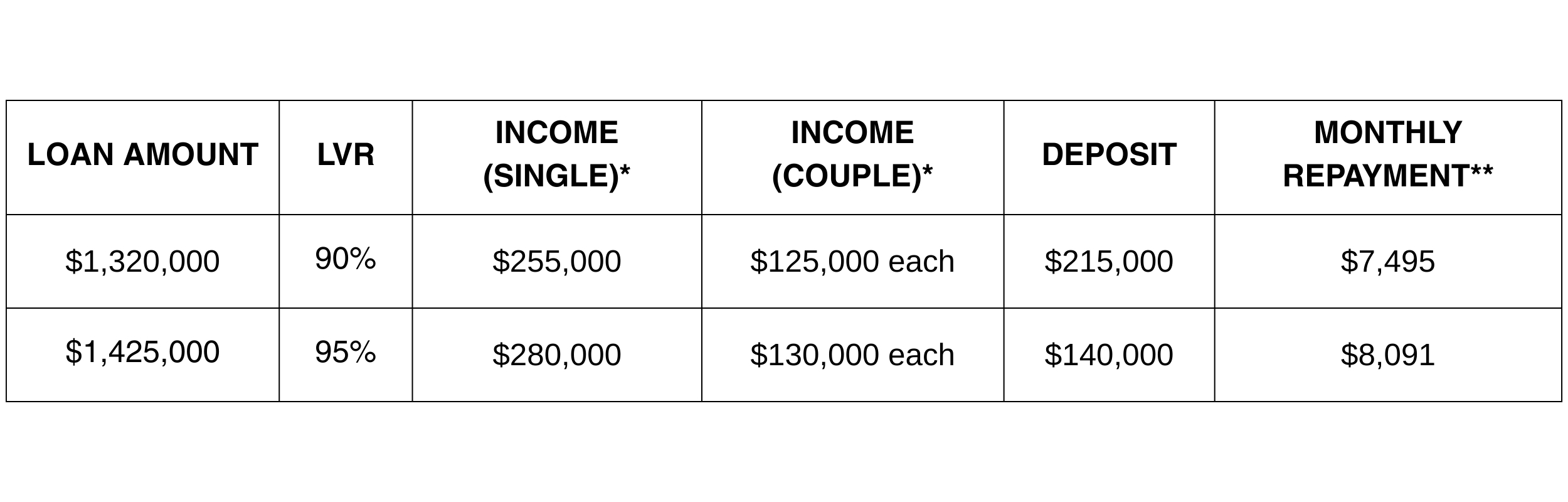
KL: Yeah so, not an insignificant amount. And I think this will help prevent the market from going completely wild. But here's some interesting info from Cotality (previously CoreLogic) that your community might find useful: previously 33% of suburbs were eligible under the old scheme price caps. With the new caps, that jumps to 63% of properties - 51% for houses and 94% for units across Australia. So Australia-wide, it's going to impact various marketplaces because anyone who was waiting to save the current average of 8 years for a deposit can now jump into the market much sooner, providing they can also afford that 90-95% loan.
So, it will have an impact, but I don't think we'll see the current growth rate (hovering around 1-2% in Sydney) suddenly jump to double digits or anything like that.
"Previously 33% of suburbs were eligible under the old scheme price caps. With the new caps, that jumps to 63% of properties - 51% for houses and 94% for units across Australia."
Section 3: Buyer Strategies & Opportunities
PF: Interesting! And are there any particular markets, suburbs, or property types in the areas you’re working in that you’re keeping a close eye on, or that you’ve noticed are in high demand?
KL: Yeah so, with my investor clients, we're focusing on the Sydney suburbs based along the new metro line for potential growth over the next 5-10 years, based on the infrastructure investment. So, suburbs like Marrickville, Dulwich Hill, Hurlstone Park, Canterbury, Campsie, Belmore - all the areas where the metro line is going in the inner corridor.
For houses, we're looking at properties within that broader metro corridor - not just the inner 10km ring, but pushing out to 15km - for potentially accelerated growth & affordability.
For apartments, we're looking at it in two different ways. We're looking at apartments in small blocks within that 400-800 metre range from train stations that could potentially be bought out by developers (due to zoning changes).
Or we're looking at small blocks just outside that intense density zone, so 1km from stations (still within walking distance), where there'll be more demand for lower-rise options when the immediate station areas get developed with high-density.
I guess the key insight here is that we're targeting those suburbs with growth potential, rather than just the more established areas, especially in this low-growth environment.
PF: In your opinion, which property types/price brackets are offering the best value or opportunities right now?
KL: In terms of value, I'm finding Melbourne to be the best at the moment. Over the last 10 years, Melbourne's average growth rate has been around 5% compared to, say, Newcastle which has been about 8% - and 8% is more where we want to be. The reason Melbourne is sitting at 5% is because the last four years have been relatively 0%, negative or just over 0% growth due to market sentiment and various other reasons, including the land tax ‘covid recovery plan’. That really did drive investors out of the market, without it necessarily being a true reflection of the impact of said tax. And so, I think there's more pent-up demand for an uplift in Melbourne in the shorter term than in Sydney.
And it's already starting to happen - Melbourne was up 1.5% last quarter compared to Sydney's 1.7%, but if you look at those quarter stats from a year ago, the difference is quite substantial. Melbourne is starting to catch up and move on that upward trajectory. But you haven't necessarily missed the boat - I think there's still more growth to go.
"Melbourne's average growth rate has been around 5% compared to Newcastle which has been about 8%... I think there's more pent-up demand for an uplift in Melbourne in the shorter term than in Sydney."
But really, my overriding thought here is that you can probably buy property anywhere in Australia, and do well from it, as long as you meet a very basic economic equation. Firstly, you have to have an imbalance between supply and demand. And secondly, it has to be in an area that has the fundamentals for that demand and under supply to continue. For demand, it needs things like multiple employment opportunities, infrastructure - ideally a university, a hospital - all these things in proximity. I mean, there’s already a bunch of places that you could eliminate straight away - anything that has only one main source of employment, like mining, or it’s really only a holiday and tourism town - eliminate. It’s not balanced enough. It doesn't have to be a capital city, it can be a regional centre, but as long as it has all those elements, and no plans to release land that would potentially dilute the supply, then, you know, give it a crack.
But to answer your original question - I do think Melbourne is undervalued at the moment, and I still see decent growth opportunity in Newcastle. I think some parts of Sydney still have growth potential too, especially the ones sitting below the average price points. And I think some parts of Queensland or Brisbane still have growth to go.
PF: Wait – MORE growth in Brisbane?!
KL: I know, I know. But from a price perspective, you can still buy a house in a decent location in Brisbane for, quite comfortably, under $1M. Which would be impossible in Sydney. So, there's still that potential for uplift. I mean, there are still risks - there's more supply, more sprawl - and I wouldn’t say I'm an expert on the Brisbane market. But I've had plenty of clients who have invested and made money there. So, I think it's possible.
But personally, I feel like Melbourne and Sydney are where I'd rather be. From an affordability point of view though, Brisbane has some criteria that works.
PF: Ok and what's happening in the investor market - are they stepping back or not? And how is investor activity affecting other buyers/the market?
KL: There's still a strong investor presence in the marketplace, though I think it's a pretty even mix between owner occupiers and investors, and I'd say investor activity is similar to last year's trends. In certain price points, owner occupiers are still winning because of that tendency for ‘love factor’ pricing - which we don't really want investors engaging in anyway.
One thing I have noticed is that some investors are focusing too heavily on yield before they properly analyse the property. I think the surplus cash required to sustain an investment in Sydney is starting to be felt, and so, they're looking for immediate returns, rather than long-term growth.
On a broader note, I'm finding there is also a little more hesitation around taking on too much debt from an investment perspective - being highly geared and highly exposed to residential real estate, things like that. Ten years ago, people would say “Oh, you need multiple properties! What are you talking about? Buy ten!” But now, it feels like there's more awareness about diversification - having some residential real estate, a decent share portfolio, things like that.
Section 4: Practical Tips & Advice For Buyers
PF: What's your advice for buyers who've been waiting for the "right time" - how should they be approaching their search strategy differently in 2025 compared to the peak years?
KL: Look personally, and after buying property for 15 years, here's what I find to be true: don't try and time or 'beat' the market. It's really not an easy thing to do, and once you realise the market is at the bottom, it's already on the rise again.
I think It's more important to focus on getting yourself a good deal within your budget. So, find the right property, do your research/analysis, work out what you think it's worth, and focus more on that.
And, as always, be prepared to hold it long term. Because, there will always be ups and downs in the market - it's about being able to ride that wave. I think the key is jumping into the market when you can, focusing on your affordability, making sure the property makes sense for you and your goals and ensuring it's at a price that you realistically feel is good value.
"Don't try and time or 'beat' the market. It's really not an easy thing to do, and once you realise the market is at the bottom, it's already on the rise again."
PF: Brilliant advice, as always. And so, are you seeing any shifts in how properties are being sold (i.e. auction vs offers prior) and how prevalent is underquoting right now? We feel like it is back with a vengeance (did it ever leave?) and what should buyers know about navigating this (illegal but widespread) practice?
KL: The majority of properties I'm working with in Sydney - so, around that 10km radius from the CBD - are auction properties. But I'd say 60-70% actually sell before auction day, or the auction dates get moved forward, depending on the vendor's circumstances.
In terms of underquoting, there's actually a massive blitz going on by the Department of Fair Trading at the moment. In the inner city ring especially, they’ve got department employees attending as undercover agents, checking on real estate agents and issuing warnings or fines if they're caught underquoting. So, they know it's a problem and they're really trying to scare agents into behaving themselves.
But unfortunately, there are ‘legal’ workarounds and what you'll probably see if you're actively looking right now is that price guides will change multiple times over a few weeks. So for example, the vendor and agent will sign an agency agreement saying they think the property is worth $1M-$1.1M. They can't legally guide lower than $1M but then they get ‘market feedback’ and say "the property is getting strong feedback, we need to increase the guide to better reflect market conditions." And so they update the guide to $1.1M-$1.2M, and then potentially again to $1.2M-$1.3M. And that's how they sort of ‘drive the price up’ without technically breaking the rules.
And look, I know underquoting really sucks, but the issue is that I've also seen agents guide the accurate price - so let’s say, instead of guiding $1.2M, they guide $1.5M because the vendor actually wants $1.5M-$1.6M. When they do the right thing and guide accurately, no one comes to the open because everyone then assumes they want $2M. So, it's a terrible catch-22.
PF: For buyers who find 'the one' - what's your advice for ensuring they are the winning party?
KL: With the majority of properties going to auction, you're not going to get a cooling off period. If a property has to go to auction, there's nothing you can do about it - you've just got to go in confidently with your bidding strategy (whatever it is - and there are multiple) and just give it your best shot. At the end of the day, if somebody's going to pay more than you, then they're going to pay more than you.
In terms of buying pre-auction, that's where you have more control. Work out what you think is the fair value of the property, work out what the vendor wants, and then usually around two weeks into the campaign is a good time to put your offer in. Have it unconditional - so, have your contract review and building reports completed, have all your contract amendments in, and then make an offer on a timed basis.
But don't go in low. There's no point making an offer on an auction property at the guide price because remember, guide prices are in the lower 10% range of what the vendor actually wants. So, if you want to secure something pre-auction, you need to be above that range at minimum. So, if it's guiding at $1M-$1.1M, you need to be thinking above $1.1M to secure it during the campaign.
"Don't go in low. There's no point making an offer on an auction property at the guide price because remember, guide prices are in the lower 10% range of what the vendor actually wants."
And if you're not in that price range, that's totally fine - it just means you're probably better off going to auction rather than trying to buy beforehand.
PF: What are the biggest mistakes you're seeing buyers make in the current market?
KL: Not having a pre-approval - that is a mistake. I’ve got a client at the moment who is really excited about a property and they said ‘I’m just going through the final stages of my preapproval’. And I said ‘well, we shouldn’t really be looking until you have it organised.’
PF: There you go people - you heard it here first!
KL: Ha ha! Well, as you would all know, you don’t really want to fall in love with a property, without knowing you’re actually able to buy it. So, step one: get your finance pre-approval organised! And it’s not that hard to renew it if you need to - so just get it.
PF: And it’s free!
KL: Exactly! And look, apart from that, there’s also what we talked about earlier - this thinking that it's ‘too hot of a market’ and that things are going to ‘shift’ and there’ll be better deals around the corner. I don’t think the market’s moving at a pace in which you can be super worried that it’s going to run away from you. But, we don’t really know what the impact will be come October 1st, and those First Home Guarantee changes come into effect - particularly in that <$1.5M market.
So, I think that if you can afford to buy now - why wait? It’s notoriously hard to time the market and I've rarely, if ever, seen it work out for people.
PF: Any other hot tips for those trying to buy in 2025?
KL: Just mostly things I've said in the past: Do your research. Try and focus on exactly where you want to be. Consider neighbouring suburbs if you're getting priced out of the suburb you're looking at. Look at infrastructure work that's going on that could potentially uplift your value in future, if you're an investor.
Also, if you're struggling to buy, and you find that you’re trying to juggle multiple different suburbs, then you need to stop and write yourself a list. So, decide on your ‘number one’ suburb choice and just focus on that one area for a few weeks or so. If it doesn't work out and you don't have luck there, then go to your number two choice.
Don't try and look at every part of Sydney at once - don't have number one, two, three, four and five all happening at the same time. Because when you compare different areas, they're all going to be different price points and you're going to get confused about what you can actually buy in each different area.
PF: As always, we know it isn't wise to put too much stock in speculation but, it's the question on everyone's lips right now: do you have any predictions for this year's spring buying season or for the rest of the year more broadly?
KL: Well, as we know, demand is back in action and supply is still not crash hot. Plus, there are more predictions for interest rate cuts over the coming months. So, I'd say this will fuel the market and put upward pressure on prices.
The growth rates we've seen in Sydney over the last year haven't been super high, but I think moving forward, growth rates are probably going to accelerate higher than what we've seen recently. I just don't think they're going to be crazy double digits - that panicked 'you've got to buy immediately otherwise it's gone up 2% in a week' situation that we've seen before. I don't think it's going to be that extreme.
But I do think, based on all the fundamentals, that the market seems like it's going to be on an upward trajectory.
PF: Amazing insights, as always, Kellie! Thanks so much for chatting with us for another year…
KL: Thanks team! Always a pleasure.

Looking for more support?
Whether you're considering your first home purchase or looking to refinance, having the right support can make all the difference. If you'd like to chat about your options or if you’ve got questions about navigating the upcoming spring market - we're here to help!
Get in touch: info@purefinance.com.au
The information provided in this article is general advice only, and doesn’t constitute personal investment and/or financial advice. You should always reach out to us, or seek personal financial advice, if you’d like to discuss your own needs.